

It's only one question - But Congress needs to know how you feel

With a flurry of congressional activity around updating the Electoral Count Act (ECA), an urgent new question has emerged. Congress wants to know how you feel about a one-fifth threshold for objections. Previously we asked you about a one-third and one-fourth threshold. Below is that section of the brief along with the one-fifth question. Please take a minute to review that proposal and weigh in. We have also included the complete ECA section of the 2022 Elections Brief in case you want to refresh your memory. Click the panel titles to expand the sections of the brief you wish to review.

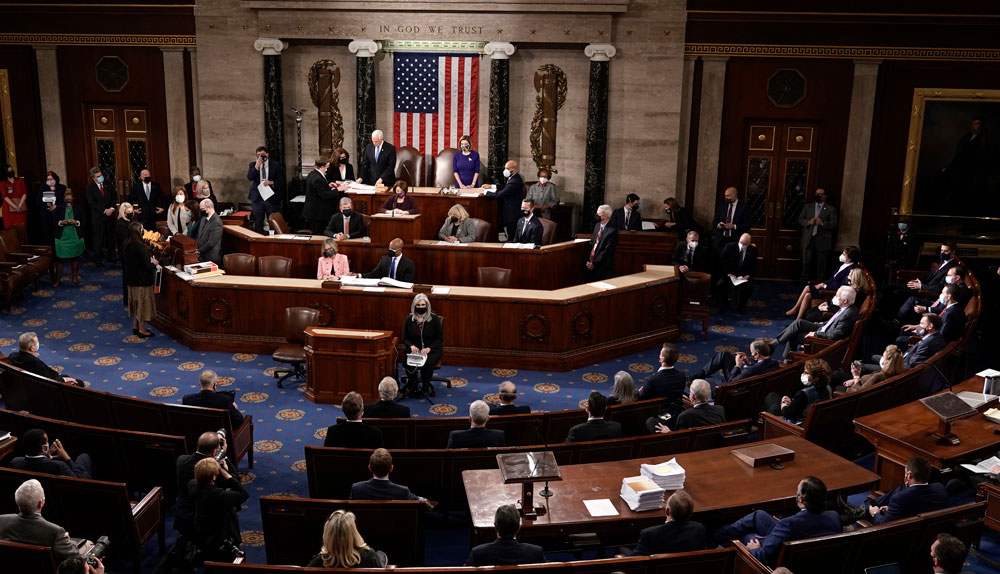
Vice President Mike Pence and Speaker of the House Nancy Pelosi, D-Calif., read the final certification of Electoral College votes during a joint session of Congress at the Capitol in Washington, Thursday, Jan. 7, 2021. (AP Photo/J. Scott Applewhite, Pool)

For over a century, the procedures that Congress followed to count the votes in the Electoral College on January 6 following a presidential election amounted to a mere formality. After all, any questions about the vote had been resolved weeks in advance. In the past two decades, however, that has changed. The congressional certification of the electors of each state is no longer simply a ceremonial formality.

It started with congressional Democrats. Beginning with the 2000 presidential election, Democrats have objected to the last three Republican presidential wins. About a dozen House Democrats objected to Florida’s electoral votes during the 2000 certification, but their efforts failed for lack of any Senate support. Four years later, after the 2004 presidential election, a group of 31 House Democrats, joined by a single Senate Democrat, objected to Ohio’s electoral votes, triggering a two-hour debate before Ohio’s slate of electors was accepted. Twelve years later, after Donald Trump’s 2016 win, a half dozen House Democrats objected to the certification of the electors of several states that Trump won but they found no senator willing to join them.

An even more serious departure from the century long practice of bipartisan respect for the established presidential election process followed the 2020 presidential election. President Trump and some Republican allies attempted to circumvent that process and reverse the result of the election in several ways.

First, President Trump and his allies attempted to convince state legislatures in states where President Biden had been certified as the winner to submit slates of electors favoring President Trump instead. They also pressured governors and other state officials in several states to certify Trump’s electors rather than the Biden electors that had legitimately won the state’s election. In addition, they attempted to convince Vice President Mike Pence to assert unilateral authority to reject certain states’ electoral votes.

Finally, President Trump and his allies organized a campaign for members of Congress to raise objections to counting certain states’ electoral votes on January 6, invoking unsubstantiated allegations of voter fraud and other improprieties that had already been rejected by the courts. As a result, six Republican senators and 121 Republican members of the House voted to object to Arizona’s electoral votes, while seven Republican senators and 138 Republican members of the House voted to object to Pennsylvania’s electoral votes. Plans to object to the electoral votes of as many as five other states were abandoned after the violent attack on the Capitol Building interrupted the Joint Session of Congress.

The escalating attempts by both parties to challenge the results of presidential elections have convinced many Republican and Democratic members of Congress, scholars, and election experts that the law governing the counting of electoral votes must be updated. There is wide bipartisan agreement that this law – the Electoral Count Act of 1887 (ECA) – is vague, antiquated, and nearly impossible to interpret.

Many members of Congress and others are particularly concerned that the existing ECA is vulnerable to politically motivated manipulation by Congress or by state officials. After all, we have seen members of Congress from both parties object to state electors during several recent elections. It isn’t a stretch to see how members, feeling pressure from their party might manipulate the results in a future election by voting to reject legitimate electoral votes.

As most Americans know, U.S. Constitution establishes a unique system for electing the president that is different in important respects from the elections we hold for any other public office. Instead of voting directly for the presidential candidates, Americans technically vote for electors selected by the candidates and their political parties. Those electors then cast votes for the presidential candidates in the Electoral College.

3 U.S. Code § 15 - Counting electoral votes in Congress

Congress shall be in session on the sixth day of January succeeding every meeting of the electors. The Senate and House of Representatives shall meet in the Hall of the House of Representatives at the hour of 1 o’clock in the afternoon on that day, and the President of the Senate shall be their presiding officer. Two tellers shall be previously appointed on the part of the Senate and two on the part of the House of Representatives, to whom shall be handed, as they are opened by the President of the Senate, all the certificates and papers purporting to be certificates of the electoral votes, which certificates and papers shall be opened, presented, and acted upon in the alphabetical order of the States, beginning with the letter A; and said tellers, having then read the same in the presence and hearing of the two Houses, shall make a list of the votes as they shall appear from the said certificates; and the votes having been ascertained and counted according to the rules in this subchapter provided, the result of the same shall be delivered to the President of the Senate, who shall thereupon announce the state of the vote, which announcement shall be deemed a sufficient declaration of the persons, if any, elected President and Vice President of the United States, and, together with a list of the votes, be entered on the Journals of the two Houses. Upon such reading of any such certificate or paper, the President of the Senate shall call for objections, if any...

-continue reading

The Constitution, as amended by the Twelfth Amendment, established an Electoral College that creates a two-stage process. In the first stage, the states appoint electors. Each state is allotted a number of electoral votes equal to the state’s total number of members of Congress in the Senate and the House of Representatives. (The Twenty-Third Amendment gives the District of Columbia three electoral votes, even though it is not represented in Congress.) States have flexibility in deciding how to appoint their electors – though since the middle of the 19th century every state has done so through a popular election.

In the second stage, once the states have appointed their electors, the electors cast their ballots in the Electoral College. In modern times, electors pledge in advance to vote for one of the candidates and many states have laws requiring electors to comply with their pledge. In practice, this means that each state’s electoral votes are cast for the candidate who wins the popular election in the state. (Maine and Nebraska have a slightly different system – some of their electoral votes are awarded to the winner of the statewide election, and some are awarded to the candidate who won the most votes in each congressional district.)

This two-stage process under the Constitution provides roles for both states and Congress. The Electors Clause of Article II of the Constitution preserves considerable discretion for states in how to choose electors: “Each State shall appoint, in such Manner as the Legislature thereof may direct, [its] Electors.” But the Constitution also gives Congress the power to determine when electors must be chosen: “The Congress may determine the Time of chusing the Electors, and the Day on which they shall give their Votes; which Day shall be the same throughout the United States.” Congress has exercised that timing power in the 3 U.S.C. §§ 1-2. Section 1 requires that states appoint electors on Election Day. Section 2 creates a limited exception to that requirement: if a state holding a popular election “failed to make a choice” on Election Day, then the state can appoint electors later “in such a manner as the legislature of such state may direct.” Congress enacted that exception in 1845 to allow states that require a majority winner (rather than just a plurality, meaning the most votes of any candidate but still less than 50%) to hold run-off elections, and possibly also to give states flexibility if a natural disaster prevents people from voting on Election Day. No one in Congress at the time suggested that Section 2 might apply based on claims of voter fraud or other election improprieties.

The two-stage process culminates with Congress counting the electoral votes after the electors cast them to determine which candidate has prevailed: “The President of the Senate shall, in the Presence of the Senate and House of Representatives, open all the Certificates, and the Votes shall then be counted.”

From early in our history, many have questioned Congress’s proper role in resolving disputes about presidential elections. That debate climaxed in the Crisis of 1876, in which officials from several states sent in competing slates of electors for different candidates. Ultimately, Congress was able to resolve that dispute, and Rutherford B. Hayes took office.

To “count” the 1876 electoral votes, Congress needed to determine which of these dueling submissions were valid. No one doubted that the states, and not Congress, have the constitutional responsibility for deciding how electors were to be appointed. But because it was faced with more than one piece of paper purporting to speak on behalf of the disputed states, Congress was forced to decide which submissions genuinely reflected the states’ appointment of electors. In 1876, there was no law in place governing how Congress should resolve the dispute. Because the House and the Senate were controlled by different parties, for months they couldn’t agree on how to proceed. Finally, they established an ad hoc Electoral Commission that resolved the dispute just days before Inauguration Day in 1877.

A decade after the Crisis of 1876, Congress enacted the ECA to prevent another crisis from arising in the future. The ECA establishes a process for Congress to count the electors’ votes and resolve any objections. The ECA directs Congress to treat a state’s final determination of a dispute about electors “by judicial or other methods” as “conclusive” so long as it is reached before a deadline in early December. Unfortunately, the ECA is complicated and vague and has failed to prevent members of Congress of both parties from making objections to state electoral counts that violate the ECA’s provisions. The Majority Staff of the Committee on House Administration has prepared an ECA report that provides a more complete history of the law and its applications.

The ECA first requires the governor of each state to send a certificate to Congress naming the state’s validly appointed electors, which in practice means that the governor sends a certificate naming the electors appointed through the state’s popular election. Then on January 6, Congress convenes to count the electoral votes. The ECA provides that for each state, the presiding officer along with several members of Congress called “tellers” open the certificates and announce the results. The vice president, who is the presiding officer, then calls for objections. If one member of the House and one senator sign the objection, the chambers separate to debate for two hours and then vote on the objection. The ECA’s procedures for resolving these objections are exceptionally complicated. In short:

  1. If Congress receives only one slate of electors purporting to be from a state that has been certified by the state’s governor, then Congress must count those electors’ votes unless they were not “regularly given” (the statute does not define this vague term.) To reject a single slate, both chambers of Congress must vote to reject it.
  2. If Congress receives multiple slates of electors purporting to be a from a state, and the two chambers agree on which one to count, then Congress counts those electors’ votes. But if the chambers disagree about which one to count, then Congress counts the slate that had been certified by the governor.

In taking these votes, the ECA directs Congress to treat a state’s final determination of a dispute about electors “by judicial or other methods” as “conclusive” so long as it is reached before a deadline in early December. However, as a practical matter there is no enforcement mechanism to ensure that Congress follows that direction. In recent years, Members of Congress have ignored the law’s requirements and made objections that were invalid because they were based on allegations that courts had already rejected.

Proposals

Over the past year and a half, members of Congress from both parties have worked to develop ECA reforms that would clarify and strengthen the process for Congress counting electoral votes. Their efforts have focused on five specific changes to the law.

1. Clarify that the Vice President has only ceremonial and procedural responsibilities

This clarification would confirm that the vice president has no substantive role in resolving disputes about electors and has no authority to reject electoral votes or to delay the proceedings.

The Case For

Supporters of this clarification argue that the Constitution vests the power to count electoral votes in Congress. Historical practice from the early years of the Republic supports that view. Congress appointed tellers to count the electoral votes beginning in 1792, and no vice president has ever attempted to exercise unilateral power to decide whether and how to count a state’s electoral votes.

Proponents contend that this constitutional history makes sense because it would be dangerous for any single person to have such expansive power to decide the results of an election. They add that the vice president is particularly likely to suffer from a conflict of interest, because he or she is frequently a candidate for re-election as vice president or for election as president. As a result, they argue, vesting the vice president with any substantive power in this proceeding creates the unacceptable risk that he or she alone would have the authority to overturn the will of the people and determine who becomes president on their own. Supporters observe that the view that the Constitution gives the vice president power to reject a state’s electors is rejected by almost all constitutional scholars. Even many supporters of President Trump agree that the Constitution does not, and should not, give the vice president the power to throw out a state’s electors on his or her own. Otherwise, in 2024 Vice President Harris would be able to dismiss the electors from states that voted for the Republican candidate.

The Case Against

Opponents of this clarification argue that the Constitution grants the vice president the authority to preside over the count, and thus to resolve disputes that arise. They further contend that no statute can limit the vice president’s powers that the Constitution grants.

2. Clarify that after Election Day a state legislature may only provide a new means to choose electors if there has been a major natural disaster or a similarly catastrophic event

The ECA currently establishes a timeline by which states must complete different steps in the process of determining their slate of electors and sending them to Congress. In the case that a state has “failed to make a choice” by Election Day, the law gives state legislatures the ability to establish a means of designating those electors after Election Day. The history shows that Congress intended the provision to apply only in the case that a major natural disaster or similarly rare and catastrophic event disrupted Election Day. This proposal would make that meaning clearer and more explicit.

The Case For

Supporters argue that this clarification is necessary to prevent a state legislature from overturning the people’s decision in an election simply because the legislature did not like the results. A broad interpretation of the existing language in the ECA might be read to give the legislature an excuse to overturn the results based, for example, on unsubstantiated allegations of voter fraud, voter suppression, or manipulation of voting machines.

Proponents argue that the clarification would still permit states flexibility if a genuinely catastrophic event kept people from voting while also preventing politically motivated manipulation.

The Case Against

Opponents argue that this proposal unwisely limits states’ flexibility in dealing with the countless ways that the integrity of the elections can be compromised and corrupted. They contend that any list of events that Congress could draft now would inevitably fail to include problems that might arise in the decades to come.

Opponents further argue that the people’s representatives rather than courts are the best institution to respond to widespread lack of confidence in the reliability of election results, regardless of the cause of those doubts.

3. Raise the threshold for objections

Under current law, if one senator and one member of the House sign an objection, then the chambers must separate for two hours of debate and then vote on the objection. With the proposed change, debate would be triggered only if a significantly higher number of members join the objection.

The Case For

Proponents of raising the objection threshold argue that current law allows fringe objections supported by very few members of Congress. These fringe objections, they contend, have no possibility of being sustained by a majority of Congress. By setting the threshold so low, current law incentivizes political grandstanding instead of serious debate.

A higher threshold still ensures that the minority party gets heard. In the past century, supporters observe, no party has ever controlled three-quarters of both chambers.

Supporters also argue that the current low threshold risks giving the false impression that the outcome of a clearly settled election is in genuine doubt and might be reversed. That false impression contributed to the atmosphere on January 6, 2021, they argue, that ultimately turned violent.

The Case Against

Opponents of raising the objection threshold argue that doing so would stifle debate and the airing of concerns about the election. They observe that the objection process simply triggers two hours of debate. After that debate, a majority of Congress must vote to sustain the objection for a state’s electoral votes to be rejected. Raising the objection threshold would not alter the rules for how Congress counts electoral votes, they argue, it only prevents minority views from being discussed.

4. Clarify the limited grounds for objections

There is wide concern that the ECA in its current form is unclear on what limits if any, restrict Congress’s power to reject electoral votes. That concern has resulted in a recommendation to include in the ECA a list of the specific grounds for objection that may be raised against counting a state’s electoral votes.

Two types of limited grounds for objection have been proposed. First, a member of Congress may object that the purported electors were not actually appointed by the state. For example, if the certificate is a forgery or the governor submits a certificate that does not reflect the results of the legal process in the state. Second, a member may object that an electoral vote violates the Constitution. For example, if the electoral vote was cast for a candidate younger than 35 years old. Any objections brought on other grounds, including that there was fraud or improprieties in the underlying popular election in the state, would be ruled out of order and would not be considered.

The Case For

Those who support clarifying the grounds for objections argue that the lack of clarity led to objections brought by Democrats in 2001, 2005 and 2017 and Republicans in 2021 that exceeded Congress’s proper role under the Constitution because states appoint electors, not Congress.

Supporters also assert that the Constitution establishes only a very limited role for Congress when it convenes to count the votes in the Electoral College. In counting the electoral votes, Congress’s authority is limited to confirming that the electors were genuinely appointed by the state and that the electoral votes are consistent with constitutional requirements. Proponents maintain that objections that scrutinize how states conducted their elections exceed those strict limits.

As Republican Leader Senator Mitch McConnell explained on January 6, 2021, “[t]he Constitution gives Congress a limited role. We cannot simply declare ourselves a national Board of Elections on steroids.” Supporters argue that those constitutional limitations are sensible. They claim that Congress is ill-equipped to investigate allegations of election improprieties, they argue. States and courts, by contrast, have extensive experience conducting recounts, considering challenges to ballots, and resolving other disputes about popular elections.

The Case Against

Opponents argue that limiting the grounds for objection would tie Congress’s hands, no matter how extensively a state’s election is plagued by fraud and illegality. In this view, Congress can serve as a final check if other institutions have failed to address grave problems in the election.

5. Clarify that Congress must honor courts’ rulings in ECA disputes

After Election Day in 2020, numerous lawsuits were taken to state and federal court, as happens after many elections. Those lawsuits addressed a wide range of allegations of voter fraud and other improprieties. The existing ECA takes some steps towards ensuring that Congress follow the decisions made by courts in those cases. For example, it says that if a state has provided a means of resolving election disputes “by judicial or other methods” that such rulings “shall be conclusive.” Still, there is wide agreement that the law is convoluted and incomplete on this point. Many have proposed a clearer provision that, if courts have decided a question about whether a state has validly determined its electors, on January 6 Congress must count those electors’ votes.

Under ECA currently, as well as with this clarification, courts do not play a substantive role in appointing electors. The Constitution clearly assigns that responsibility to the states. Instead, courts play the limited role of determining which electors the states had already appointed according to the laws in place on Election Day.

The Case For

Supporters of clarifying that Congress must honor courts’ decisions in ECA disputes observe that members of Congress raised objections on January 6, 2021, even though many of those objections had already been rejected by the courts. They also argue that courts are better suited for resolving election disputes than politicians. Proponents observe that our legal system recognizes that while Congress is well-suited to draft and enact legislation by balancing competing policy concerns, courts are better suited to resolve contested questions of law and fact that arise in a particular dispute.

Supporters further observe that courts resolve litigation about presidential elections every cycle, including the U.S. Supreme Court in 2000 in Bush v. Gore, and the dozens of decisions in 2020 that rejected President Trump’s claims of election fraud. Proponents observe that the proposal would simply ensure that in the future, Congress respects the results of those judicial decisions, as it always has in the past.

The Case Against

Opposition to clarifying that Congress must honor court rulings in ECA disputes come from opposing sides. On one side, some argue that any ECA update should go further than clarifying the existing understanding of courts’ roles under the ECA. They argue that federal courts should be given an expanded role. These opponents argue that judges in state courts are often less independent and more politically motivated, because in many states, judges are elected rather than appointed for life, like federal judges. With rising political pressures in our bitter partisan times, they argue, the independence of federal courts is needed.

Other opponents of clarifying that Congress must honor court rulings argue that the role of courts in election disputes should be even more limited than it is now, especially the role of federal courts. Many of the opponents in this camp argue that the Constitution explicitly grants the authority for determining how a state chooses its electors to state legislatures. These opponents argue that this is a wise constitutional provision because state legislatures are elected by the people and are closest to the people.

6. Limit judicial review of claims under the ECA and other federal statutes to candidates for president and vice president

There is bipartisan interest in limiting the right to file a federal lawsuit under the ECA and other statutes to candidates for president and vice president. Generally, a federal court may consider a lawsuit that raises a federal question. This clarification would prohibit a federal court from deciding a federal statutory claim if raised by someone who is not on the ballot as a candidate for president or vice-president.

This clarification would not limit the existing rights of those who could bring a claim in federal court under the U.S. Constitution, including challenges brought under the Equal Protection and Due Process clauses and Congress’s constitutional power to set the date for Election Day.

The Case For

Supporters argue an aggrieved candidate for president and vice president would certainly have a sufficient interest to pursue any serious claim under federal statutes that called into doubt the results of a presidential election. If even the candidates themselves don’t feel that there is a sufficient federal statutory question to warrant a lawsuit, proponents argue, then the country should be spared the uncertainty and disruption that could be caused by overly litigious actors wishing to create controversy where there really isn’t any.

The Case Against

Opponents argue that presidential and vice-presidential candidates aren’t the only ones who are adversely affected if those candidates were determined to have lost the election because a federal statute was violated. They argue that political parties, members of Congress, and even individuals who voted for the aggrieved candidates should be able to bring a federal lawsuit if they can show that federal court review is required to address the injury.