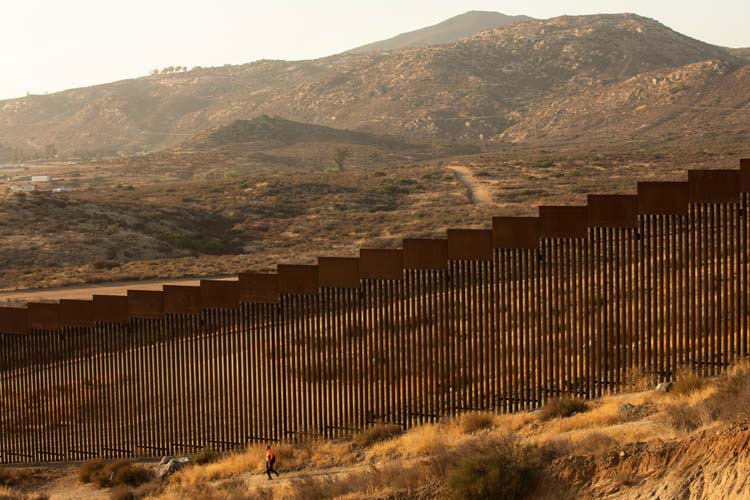
The most direct way to keep the border secure is to construct a physical barrier, enhanced by technology, along much more of the 2,000-mile US-Mexico border than the 800 miles that already exist. President Trump requested and received $46.5 billion in OBBBA to construct a border wall and infrastructure system. That system includes an additional 700 miles of physical barrier. This would leave 500 miles without a physical barrier because they are extremely difficult to build on. These stretches are already very difficult to cross, even without a wall. The border wall plans include installing large floating barriers in 500 miles of the Rio Grande River, which comprises about two-thirds of the US-Mexico border, as well as walls on the US side of the river. The $46.5 billion also funds detection technology integrated into the wall system itself — cameras, lights, and sensors — that enhances the effectiveness of the physical barriers.
OBBBA also provides roughly $6.2 billion for free-standing border detection technology that operates independently of any physical barrier. The largest category is Autonomous Surveillance Towers — free-standing towers equipped with cameras, sensors, and onboard artificial intelligence that detect and classify people, vehicles, and other items of interest in real time without requiring continuous human monitoring. The $6.2 billion also funds mobile surveillance systems, counter-drone systems, small unmanned aerial systems, and additional air and marine surveillance assets. Taken together, OBBBA’s total physical barrier and technology investment — barrier-integrated technology plus free-standing technology — to secure the southern border is approximately $52 billion.
This proposal would pass policy legislation to make the border wall and infrastructure system funded by OBBBA durable across future administrations.
The Case For
Supporters of this legislation generally fall into one of two distinct categories.
Pro-Immigration
vs
Restrictionists
Pro-Immigration
Some who are pro-immigration support making OBBBA’s barrier system permanent because they believe securing the border is an important part of channeling migration through legal pathways (the "gates"). Visas can be issued to those we want to welcome, including employment-based visas for jobs where workers are most needed.
These supporters emphasize that channeling migration through legal pathways with a more secure border protects migrants themselves. They observe that crossing illegally poses enormous physical dangers and risks of exploitation from self-serving paid guides who often work for cartels. These supporters note that undocumented immigrants also face a range of dangers once they're in the US from unscrupulous employers and others seeking to exploit their precarious status. If we want to be a nation that welcomes and respects immigrants, these supporters argue, we should do that through legal immigration channels rather than looking the other way at a porous southern border.
vs
Restrictionists
The most avid barrier system supporters come from the restrictionist camp. They argue that a strong physical barrier system at the southern border is important in principle to uphold the rule of law and to protect Americans, including from the dangers posed by cartels. Restrictionist supporters argue that the wall system deserves to be made more permanent through legislation because it is fundamentally about national sovereignty and a government's most basic duty: keeping its communities safe. They contend that porous borders actively invite crime and illegal immigration. Many argue that a significant portion of those crossing illegally in recent years are violent offenders . Even if the percentage of those who commit additional crimes is low, these supporters argue that a sovereign nation should never willingly expose its citizens to preventable danger by allowing unvetted individuals to bypass legal checkpoints.
Restrictionists also argue that an unsecured border inflicts serious economic damage in two ways. First, they contend that mass illegal immigration imposes significant harm on working-class Americans. When foreign workers bypass the legal system, they flood the blue-collar labor market, replacing American-born workers and driving down wages for native citizens already struggling to make ends meet . They argue that a continuous supply of foreign labor removes the pressure that would otherwise push employers to raise wages and improve conditions for American workers.
Second, restrictionists argue that relatively open borders drain resources by inviting foreigners who rely on our country's generous benefits and services, from education to healthcare . They argue it breaks the social contract to expect everyday American taxpayers to fund expensive support systems for individuals the nation did not invite. For this camp, illegal immigration is fundamentally unfair to the citizens who pay into the system and the legal immigrants who wait years in line.
The Case For
Supporters of this legislation generally fall into one of two distinct categories.
Pro-Immigration
Some who are pro-immigration support making OBBBA’s barrier system permanent because they believe securing the border is an important part of channeling migration through legal pathways (the “gates”). Visas can be issued to those we want to welcome, including employment-based visas for jobs where workers are most needed.
These supporters emphasize that channeling migration through legal pathways with a more secure border protects migrants themselves. They observe that crossing illegally poses enormous physical dangers and risks of exploitation from self-serving paid guides who often work for cartels. These supporters note that undocumented immigrants also face a range of dangers once they’re in the US from unscrupulous employers and others seeking to exploit their precarious status. If we want to be a nation that welcomes and respects immigrants, these supporters argue, we should do that through legal immigration channels rather than looking the other way at a porous southern border.
vs
Restrictionists
The most avid barrier system supporters come from the restrictionist camp. They argue that a strong physical barrier system at the southern border is important in principle to uphold the rule of law and to protect Americans, including from the dangers posed by cartels. Restrictionist supporters argue that the wall system deserves to be made more permanent through legislation because it is fundamentally about national sovereignty and a government’s most basic duty: keeping its communities safe. They contend that porous borders actively invite crime and illegal immigration. Many argue that a significant portion of those crossing illegally in recent years are violent offenders . Even if the percentage of those who commit additional crimes is low, these supporters argue that a sovereign nation should never willingly expose its citizens to preventable danger by allowing unvetted individuals to bypass legal checkpoints.
Restrictionists also argue that an unsecured border inflicts serious economic damage in two ways. First, they contend that mass illegal immigration imposes significant harm on working-class Americans. When foreign workers bypass the legal system, they flood the blue-collar labor market, replacing American-born workers and driving down wages for native citizens already struggling to make ends meet . They argue that a continuous supply of foreign labor removes the pressure that would otherwise push employers to raise wages and improve conditions for American workers.
Second, restrictionists argue that relatively open borders drain resources by inviting foreigners who rely on our country’s generous benefits and services, from education to healthcare . They argue it breaks the social contract to expect everyday American taxpayers to fund expensive support systems for individuals the nation did not invite. For this camp, illegal immigration is fundamentally unfair to the citizens who pay into the system and the legal immigrants who wait years in line.
Both supporting camps argue that the border wall system is also critical to limiting cartels. Advocates argue that we should no longer tolerate cartels’ exploitation of an insecure border to advance their extensive criminal enterprises, including drug smuggling and human trafficking.
Proponents also argue that the wall system is most effective when its physical barriers work in combination with free-standing detection technology. The wall channels and slows crossers in the most heavily trafficked stretches, while Autonomous Surveillance Towers, mobile surveillance, and air assets extend coverage to remote areas where building a wall is impractical. The barrier-integrated cameras, lights, and sensors tie the two layers together by giving Border Patrol real-time awareness along the wall itself. While no approach is foolproof, proponents observe that the system combining physical barriers with technology slows and redirects crossers, giving agents crucial time to apprehend them, and deters others from ever attempting the journey.
The Case Against
Opponents of the border wall and infrastructure system argue that it doesn’t justify the $52 billion in funding in the first place, let alone justify making itan enduring legislative policy. They argue that the barrier system is the wrong tool for the actual problem. They note that over 40 percent of those in the country without status entered legally and overstayed their visas (the vast majority on short-term tourist, business, or student visas)—a problem the wall system does nothing to address.
As for the other 60 percent of those without legal status, opponents argue the system is far less effective at mitigating crossings than supporters claim. They argue that even if the wall has reduced crossings at its existing locations, many successful crossings continue — including by cutting through, climbing over, or tunneling under it. These methods of defeating the wall reduce its effectiveness and significantly increase its maintenance costs beyond the original construction.
Opponents also note that the wall does little to stop one of the largest categories of border encounters: asylum-seekers. The physical barriers are built entirely on US territory, so migrants arrive at the wall and surrender — they don’t need to cross it for US asylum law to apply. The wall doesn’t deter them; in fact, Border Patrol must work around it to reach them and begin the asylum process.
Opponents also dispute that the system meaningfully disrupts cartels. They argue that cartels move the vast majority of drugs through legal ports of entry, hidden in commercial cargo and passenger vehicles, where the wall system is irrelevant. Stopping cartel trafficking, in their view, requires investment in port-of-entry inspection capacity, not barriers across remote stretches of the border.
Many opponents also raise concerns about the free-standing detection technology component of the system, separate from their concerns about the physical barriers. The Autonomous Surveillance Towers, in particular, have drawn criticism because they use artificial intelligence to detect and classify people in real time, with limited public transparency about how that classification works or how reliably it performs across different populations. Civil-liberties advocates argue that expanding AI-driven surveillance infrastructure along the border establishes a precedent for using such systems in other domestic contexts, with implications for privacy and due process that extend well beyond border enforcement. Some opponents also note that the towers and other free-standing surveillance assets are concentrated near border communities, where residents — many of them US citizens — must live under constant monitoring by systems designed to detect unauthorized crossings.
Some also argue that the wall represents an unnecessary militarization of the border, dividing US and Mexican communities that have been linked for hundreds of years. Native American tribes argue that the wall bisects their territories, separates tribal members from one another in violation of treaties, and has damaged sacred sites and burial grounds during construction. Environmentalists note the wall’s impact on sensitive habitats and on natural water flows governed by a US-Mexico treaty.
Some opponents also argue that the wall has had serious humanitarian consequences. By blocking easier crossing points, it has channeled migration into more remote and dangerous terrain — particularly desert regions where exposure deaths have risen significantly as the wall has expanded.
Opponents also note that many locations along the border are owned by private entities. Gaining control of this land is expensive, they argue, and disrespectful to American landowners’ private property rights.
Most opponents also reject supporters’ arguments about the negative effects that immigrants have on the country. They argue that crime rates among those here without legal status are significantly lower than those of native-born Americans . They further argue that immigrants do not depress wages for native workers and that immigrant labor drives economic growth and creates new jobs for native workers . They also maintain that undocumented workers pay more in taxes than they consume in government services .
Credible research indicates that immigrant workers can sometimes take the place of some native workers, which economists call the substitution effect. These substitution effects tend to concentrate among US workers with whom immigrants share similar skills, such as lower-skill minorities and prior immigrants, although the size of the effects on minorities is contested. Evidence also shows that when businesses can’t hire temporary workers in jobs for which it’s especially hard to find native-born workers, the businesses shrink and hire fewer native workers too. In the opposite scenario, reputable studies also confirm that when businesses are able to hire immigrant workers into hard-to-fill jobs, they expand more and hire more native workers in other jobs needed at that business, which economists call the scale effect. A growing body of research suggests that the scale effects are much larger than the substitution effects, meaning that hiring immigrants generally has no broad negative effect or creates more jobs for native workers, not fewer. Studies consistently find that immigrants are about 50% more likely to start new businesses than natives, from small businesses to industrial giants. Because entrepreneurs on average create jobs, a workforce with relatively more immigrants creates jobs for native workers more than a workforce with relatively fewer immigrants. According to the best available evidence the net effect of immigrant workers is to stimulate the creation of more jobs for native workers and significantly grow the economy, but evidence is less conclusive on the impacts for concentrated groups of US workers who may compete more directly with new immigrants.
While some claim that higher numbers of undocumented immigrants in an industry can lead to worse working conditions, and negatively impact US workers as a result, there is little evidence indicating that these spillover effects are common or related to the presence of undocumented workers. While a greater supply of undocumented labor puts downward pressure on the wages of natives who remain in directly competing roles, it puts upward pressure on the wages of natives who shift into complementary tasks. In the best evidence we have, these effects roughly balance for workers at the same firm, with a negligible positive effect on the wages of native coworkers. Studies suggest that undocumented workers themselves face lower wages and are not compensated as much when working in dangerous conditions. The evidence suggests that unscrupulous employers may take advantage of workers’ lack of legal status to cut corners on wage and safety laws, since undocumented workers are less likely to file complaints out of fear of deportation. It’s clear that undocumented workers themselves are the most disadvantaged by their lack of legal status, and evidence indicates that overall impacts on US workers are not substantial.
What the Evidence Says—Native Workers' Wages
The effect of immigrants on native workers' wages is among the biggest concerns expressed in Congress and among Americans, and as a result economists have rigorously studied this topic. The best economic analyses consistently show that the long-run, total impact of increased immigration on Americans' average wages is nearly zeroFour authoritative economic studies each contribute to this consensus. The first study is an extremely comprehensive review performed by economists and experts assembled by the National Academies' Committee on National Statistics. Their Panel on the Economic and Fiscal Consequences of Immigration was a politically balanced group of researchers, and the report represents a nuanced review of the effects of immigration across many individual studies, supported by a diverse and broad coalition of experts. The report found that the aggregate long-run impacts of immigration on native workers' wages is close to zero. Using a variety of economic assumptions in one study's statistical models, the long run effects for all workers remained consistently close to zero.
The second paper involved a review of 27 different economic studies and their estimated effects of immigration on wages. The review found that half of the effects were not statistically significant, meaning there is not sufficient evidence that their results are different from random chance. The paper also noted that most of the 27 studies did not find a more negative effect for less-educated native workers than it did for native workers generally.
The third paper, by the Bipartisan Policy Center, reviewed leading economic analyses to synthesize the understanding of immigration's impact on native wages. The review again found that immigration has small effects on wages in the US, and that differences in study design contribute to the ongoing disagreement about impacts for specific groups of American workers. The paper reviewed that if negative wage effects are to occur, they're most likely to occur for workers with less education. The paper also found that these workers sometimes transition to higher-skilled careers and positions to mitigate negative effects on their wages.
Finally, a fourth study analyzed the impacts of immigration in developed countries around the world, and found that the long-run, overall effects on the wages and employment of native workers are zero or even slightly positive. The study notes that as businesses and economies adjust to sudden changes in labor markets, some unexpected immigration surges can have negative effects in the short-term.. One of the best analyses of 27 different economic studies finds that in 19 of these 27 studies, a 1% increase in immigrants' share of the labor force predicted changes to native workers' wages narrowly ranging between -0.1 and 0.1 percent. Applied to today's economy, these findings indicate the median American family could see their income change, rising or falling, by about $63 a year if 1.67 million more immigrants enter the workforce. The best studies may show a negative impact or a positive one, but the size of these impacts is consistently very small. There may be few issues in all of economics on which there is stronger consensus.
Because many immigrants arrive in the US with lower levels of formal education, there is special concern among policymakers about the impacts of immigration on Americans whose highest educational level is a high school degree or lower. Under a strict series of economic assumptions (primarily about the degree to which different US and immigrant workers act as substitutes to each other in the labor market) some economic studies find a larger negative effect of immigration on wages for Americans without a high school degree. Using these same assumptions, the effects on the wages of those with a high school degree are positive and outweigh any total negative wage effects from immigration. Under equally plausible economic assumptions, research has even found positive effects on the wages of Americans with less than a high school degree. Using real-world data from a massive influx of Cuban immigrants into Miami in 1980, economists found a near-zero impact of the rapid increase in immigrants on the wages of native workers, even on those with only high school degrees.
While there is mixed evidence regarding the impacts of immigration on the relatively small number of Americans with less than a high school degree, economic evidence consistently demonstrates that other factors have been far more responsible for declining wages among the much larger group of those with a high school degree or less. Between 1979 and 2019, these Americans saw their median real (inflation adjusted) wages decrease by 13.7% while wages for Americans with a bachelor's and advanced degree increased by 9.2% and 27.2% respectively. The best economic studies attribute these relative wage losses mostly to technological shiftsTwo studies indicate that technological shifts were a primary factor in the relative wage declines of Americans with a high school degree. The first study finds that between 50% and 70% of changes to wage structure in the US from 1982 - 2022 can be explained by the declining wages of workers most vulnerable to the rapid technological automation underway during this period. Their study created and tested a model that predicts declining wages based on the degree to which workers have their tasks displaced by technology, and found striking correlation. The study found evidence that automation-associated wage inequality can accompany productivity growth in the economy, indicating that the economic gains with technology can arrive with real losses to those most impacted by its arrival.
The second study complements the results of the first by developing a task-based framework that considers jobs as concentrated around a series of tasks that each worker must complete. The study finds that technological changes that increase productivity of high-skill workers, like the introduction of advanced computers, can hurt low-skill workers whose tasks are more easily automated. Where workers are replaced by technology, or have part of their jobs automated, the evidence indicates their jobs can face relative wage losses. and somewhat to changes in international trade (especially with China). These studies generally conclude that immigration was not an important factor in the relative wage losses of Americans with high school degrees. Finally, evidence indicates that the effects of immigration policy choices depend on other policy decisions by the government. For example, the small labor market effects of immigration on the least-skilled natives are most benign in states that have adopted the strongest labor-market protections for all workers, native and immigrant alike.
What the Evidence Says—Taxes vs. Government Services
Using recent data from massive inflows of many immigrants, not just undocumented ones, the Congressional Budget Office (CBO) estimated that the additional surge of arrivals from 2021 to 2026 generated about four times as much federal revenue through the taxes they paid ($788 billion) and economic activity they created ($412 billion) as they cost in federal government services ($177 billion) and net interest on the debt ($133 billion).Consequently, CBO projected the federal deficit would be reduced by $0.9 trillion through 2034 due to those arrivals.
The CBO finding of a large positive federal fiscal effect of recent undocumented immigrants does not contradict studies estimating that undocumented immigrants individually pay less in taxes than the public expenditures they benefit from.The CBO estimates account for immigrants’ ripple effects on the economy, such as additional tax revenue from corporate income tax or capital gains by the shareholders of immigrants’ employers. Methods that account only for fiscal flows to and from immigrants themselves omit such ripple effects. A low-wage immigrant worker as an individual might pay somewhat less in income taxes, sales taxes, and property taxes than the costs of public schooling and road maintenance they benefit from, even as tax revenue from the industries sustained by immigrants’ labor and consumption more than make up for the difference – as the CBO finds.
State and Local Level: Undocumented Immigrants Use More than They Pay—Estimates at the local level tend to find negative net impacts of all immigration from lower tax revenues and higher costs to governments providing services like public education. The CBO found in a 2007 report that undocumented immigrants in particular paid modestly less in state and local taxes than they cost. Another CBO study found that state and local governments spent $9.2 billion more on government services in 2023 at the peak of the surge for the additional immigrants (undocumented and other foreign national arrivals) than they paid in state and local taxes. The estimated negativefiscal impact of immigrants on state and local budgets is roughly one tenth the size of the positiveimpact at the federal level. The highest cost at the state and local level is mostly for K-12 public education. States are legally required to educate all children regardless of immigration status.
You're viewing a single section of this policy brief.